
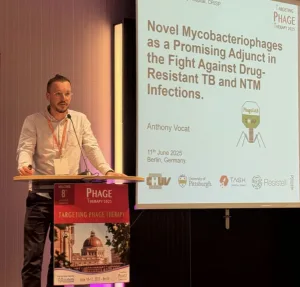
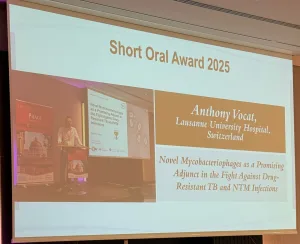
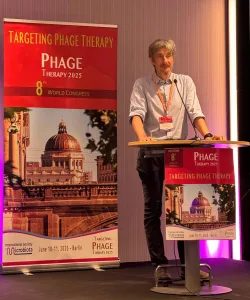
Congratulations to Anthony Vocat winner of the Short Oral Award 2025! His outstanding presentation, “Novel Mycobacteriophages as a Promising Adjunct in the Fight against Drug-Resistant TB and NTM Infections” captivated the scientific committee with its scientific rigor and real-world impact. His work highlights the innovative potential of bacteriophage therapy in addressing one of the most pressing global health challenges: drug-resistant tuberculosis and non-tuberculous mycobacterial infections.
About his Research and Future Steps:
The 37-year-old Swiss microbiologist with over a decade of experience in infectious disease research, particularly Mycobacterium tuberculosis pursues a PhD at CHUV / Centre hospitalier universitaire vaudois, under the supervision of Dr. Grégory Resch and Prof. Gilbert Greub within the CRISP group. His research focuses on discovering and characterizing new bacteriophages active against mycobacteria and Pseudomonas-related lung infections. The project includes isolating phages from environmental samples and developing ultra-rapid phage susceptibility testing (PST) using nanomotion technology, in collaboration with Resistell.”
Bravo Dr. Vocat for this well-deserved recognition and for pushing the boundaries of infectious disease research!


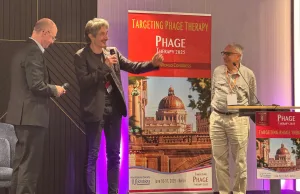
 Prof. Dr. Christian Willy from Military Academic Hospital Berlin, Germany will give concluding remarks and deliver his vision on How phage therapy may evolve in the coming years.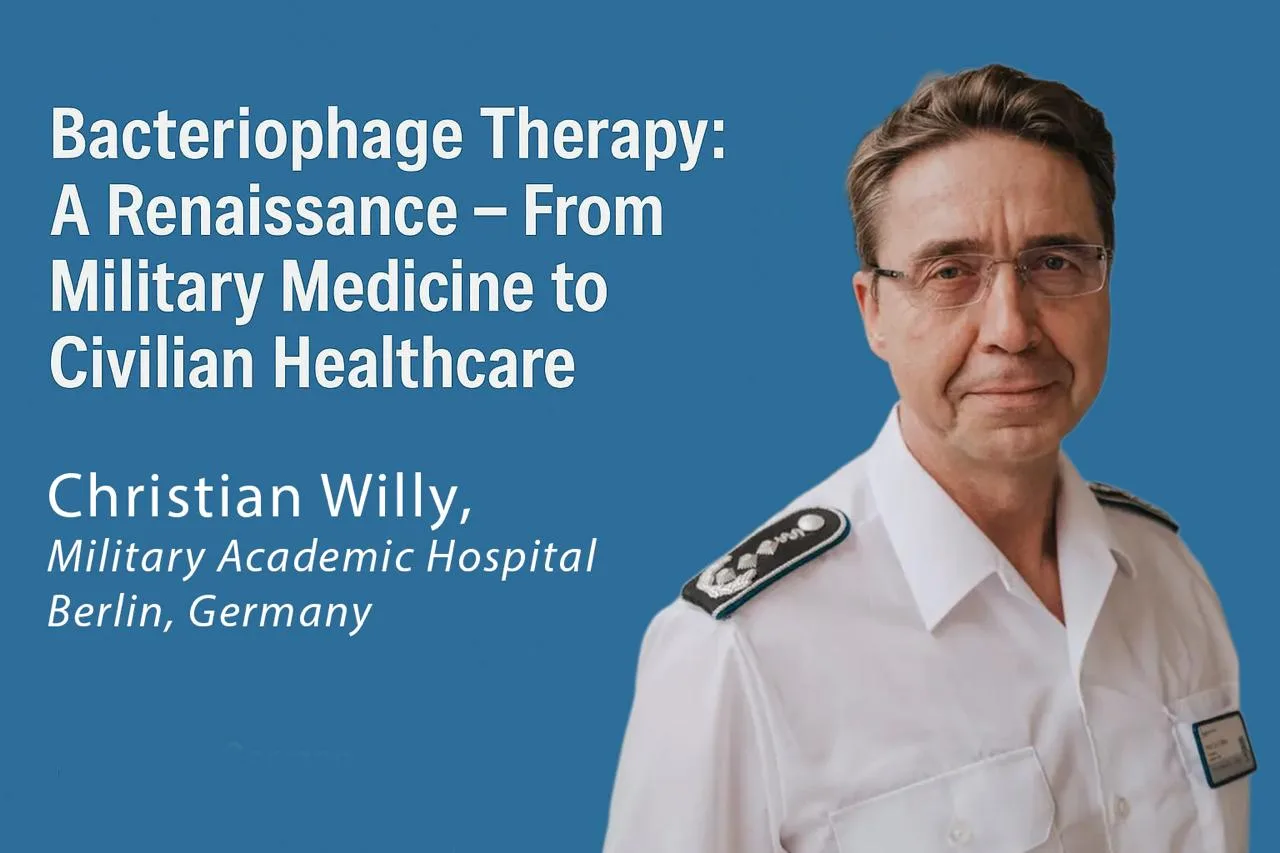
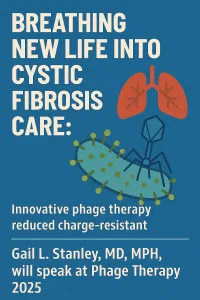 In a promising breakthrough against antibiotic-resistant infections, researchers have harnessed personalized bacteriophage therapy to combat Pseudomonas aeruginosa in adults with cystic fibrosis (CF). The innovative approach—designed to exploit bacterial “trade-offs” that weaken resistance or virulence—was used to treat nine CF patients with compassionate-use nebulized phage therapy.
Congratulations to Prof. Alberto Danielli from the University of Bologna, Italy, for receiving the Scientific Contribution Award at Targeting Phage Therapy 2025! His remarkable talk, “Targeting Tumors with Engineered Phages: A New Frontier in Precision Oncology”, opened exciting perspectives on how phage technology can be harnessed to advance precision cancer therapies.
A well-deserved recognition for pioneering research at the intersection of phage engineering and oncology.
Thank you, Prof. Danielli, for your inspiring contribution to the field!